An Overview of Underground Coal Gasification
-
Keywords:
Underground Coal Gasification (UCG), In-situ Coal Conversion, Synthetic Gas Production, Coal Seam, Environmental ImpactAbstract
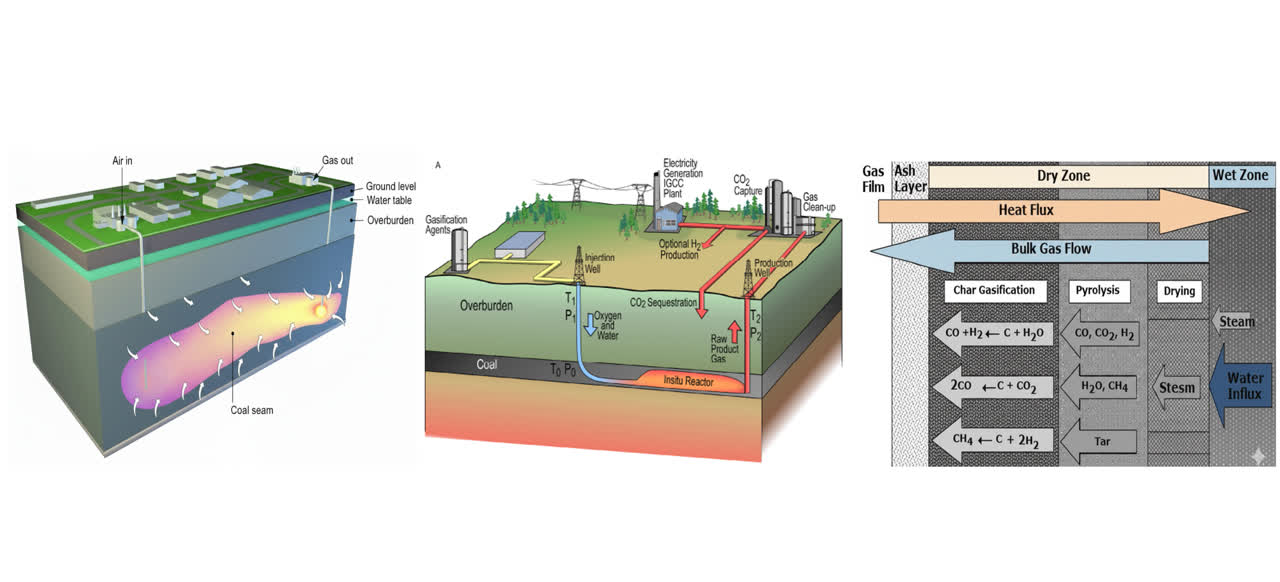
Underground coal gasification (UCG) represents a promising and cleaner approach to harnessing unmined coal reserves, offering a viable alternative to traditional coal extraction methods. While conventional mining recovers only 15-20% of total coal reserves, UCG has the potential to significantly extend the life of global coal resources by accessing otherwise unrecoverable deposits. Traditional mining is resource-intensive, requiring substantial time, labour, and machinery, and poses environmental and safety challenges such as landscape disruption, high operational costs, and risks to personnel. UCG circumvents these issues by gasifying coal in situ through a network of wells, where the coal is ignited and sustained by injected oxidants, producing syngas—a mixture primarily of carbon monoxide and hydrogen. This syngas can be used for industrial heating and power generation or converted into hydrogen, synthetic natural gas, and liquid fuels. Compared to surface mining and gasification, UCG offers reduced capital and operational expenses, fewer greenhouse gas emissions, and can be integrated with carbon capture and storage (CCS) technologies. With increasing global energy demand, oil and gas reserves depletion, and growing concerns over climate change, interest in UCG has risen worldwide. The process holds immense potential for exploiting low-grade, inaccessible coal seams and converting them efficiently into syngas, with wide-ranging energy, fuel, and chemical production applications. This report comprehensively analyses UCG technology, tracing its evolution and key projects globally. It examines site selection criteria, highlighting the importance of coal geology, coal properties, and geological and hydrological conditions. The report also reviews various UCG methods and the chemical and physical processes involved and explores process optimization and the influence of different operational parameters. Furthermore, the environmental and economic implications of UCG are assessed, alongside its advantages and disadvantages. This paper is an in-depth review of the fundamental concepts and technologies driving UCG, offering a detailed insight into this evolving coal conversion method.
Downloads

Published
Issue
Section
License
Copyright (c) 2025 Azraa Kader (Author); Amir Hossein Mohammadi (Corresponding author)

This work is licensed under a Creative Commons Attribution-NonCommercial 4.0 International License.