Comparison of the Impact of NPC and Alumina/Silica Nano Hybrid Emulsion on CEOR
Keywords:
Smart Water, Interfacial Tension (IFT), Nanocomposites, Nano Hybrid Emulsion, Chemical Enhanced Oil RecoveryAbstract
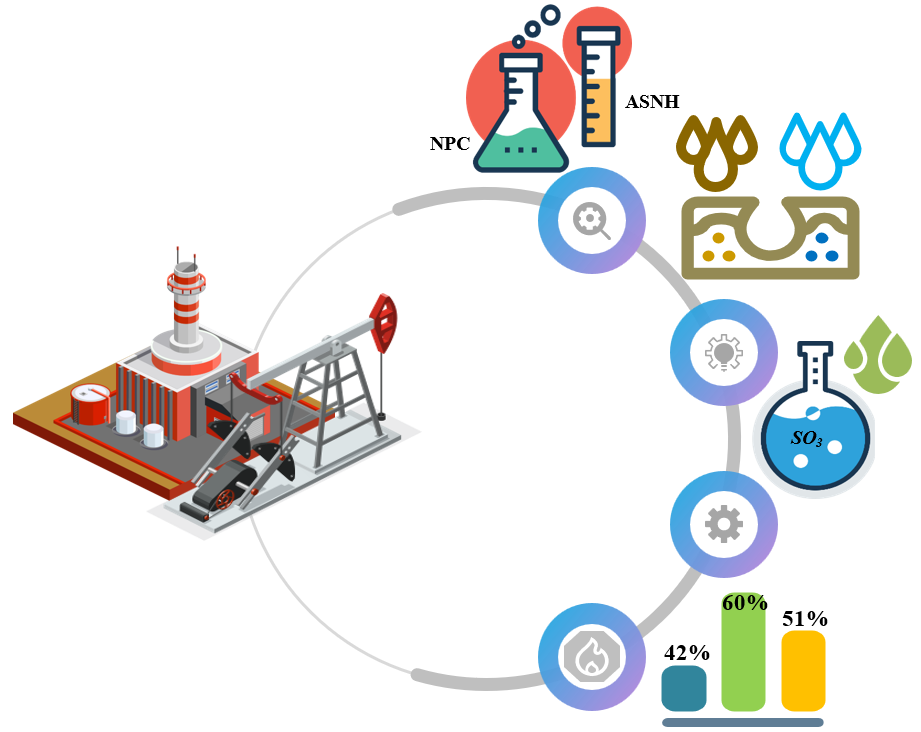
This study delves into the potential benefits of utilizing smart waterflooding as a method for improving oil recovery in carbonate reservoirs. Unlike traditional methods that rely on costly or hazardous chemicals, this approach employs the use of nanoporous carbon (NPC) and alumina/silica nanohybrid emulsion (ASNHE) to investigate their impact on interfacial tension (IFT) and wettability alteration on carbonate reservoir rocks from Asmari formation, as well as their combined synergistic effects on oil recovery. The research found that increasing the concentration of sulphate up to four times in the presence of other ions resulted in the most significant alteration of rock wettability towards water-wet. This suggests that smart waterflooding has the potential to be an effective method for improving oil recovery without the need for expensive or hazardous chemicals. Additionally, the study revealed that the use of ASNHE significantly reduced the oil/water IFT, resulting in a notable increase in oil recovery. Specifically, the use of seawater flooding resulted in a 42% increase in oil recovery, while SW4S+NPC and SW4S+ASNHE flooding resulted in an increase of 60% and 51%, respectively. Overall, the findings of this research paper suggest that the use of smart waterflooding, combined with NPC and ASNHE, has the potential to be a promising approach for improving oil recovery in carbonate reservoirs. By reducing the need for costly and hazardous chemicals, this method could provide a more sustainable and economically viable solution for the oil and gas industry
Downloads
References
M. Akbar, B. Vissapragada, A. H. Alghamdi, D. Allen, M. Herron, A. Carnegie, D. Dutta, J.R. Olesen, R. D. Chourasiya, D. Logan, & D. Stief, (2000). Oilfield Review, 12(4), 20-21..
S. Thomas, (2007). Oil & Gas Science and Technology - Revue de l'IFP.
L. Hendraningrat, S. Li & O. Torsæter, (2013), Journal of Petroleum Science and Engineering. 111, 128-138.
R. Nazari Moghaddam, A. Bahramian, Z. Fakhroueian, A. Karimi, A. Sharareh, (2015). Energy & Fuels, 29.
Nhu Y, Le & Pham, Duy & Le, Kim & Nguyen, Phuong-Tung. (2011). Design and screening of synergistic blends of SiO2 nanoparticles and surfactants for enhanced oil recovery in high-temperature reservoirs. Advances in Natural Sciences: Nanoscience and Nanotechnology. 2.
Nwidee, L. & Al-Anssari, Sarmad & Barifcani, Ahmed & Sarmadivaleh, Mohammad & Lebedev, Maxim & Iglauer, S.. (2016). Nanoparticles Influence on Wetting Behaviour of Fractured Limestone Formation. Journal of Petroleum Science and Engineering. 149.
P. Esmaeilzadeh, et al.(2025), Journal of Natural Gas Science and Engineering ,26, 1294-1305.
M.S. Moslan, W.R.W. Sulaiman, A.R. Ismail, M.Z. Jaafar. Chemical Eng. 65 (2017) 1339–1344.
A. Esfandyari Bayat, R. Junin, A. Samsuri, A. Piroozian, M. Hokmabadi, Impact of metal oxide nanoparticles on enhanced oil recovery from limestone media at several temperatures, Energy Fuels 28 (2014) 6255–6266.
S. Li, O. Torsaeter, The Impact of Nanoparticles Adsorption and Transport on Wettability Alteration of Intermediate Wet Berea Sandstone, SPE Middle East Unconventional Resources Conference and Exhibition, 2015.
E. Joonaki, S. Ghanaatian, The application of nanofluids for enhanced oil recovery: effects on interfacial tension and coreflooding process, Petro. Sci. Tech. 32 (2014) 2599–2607.
Nazarahari MJ, Manshad AK, Ali M, Ali JA, Shafiei A, Sajadi SM, et al. Impact of a novel biosynthesized nanocomposite (SiO2@ Montmorilant@ Xanthan) on wettability shift and interfacial tension: Applications for enhanced oil recovery. Fuel 2021;298:120773.
El-Sherbini, N. M., El-Khodary, A. A., & El-Sherbini, M. M. (2014). Effect of solid lipid nanoparticles on interfacial tension between water and oil. Egyptian Journal of Petroleum, 23(2), 185-192.
Hossain, M. A., Alam, M. K., & Islam, M. N. (2010). Magnetic nanoparticles for enhanced oil recovery. Colloids and Surfaces A: Physicochemical and Engineering Aspects, 362(1-3), 201-207.
El-Sherbini, N. M., El-Khodary, A. A., & El-Sherbini, M. M. (2014). Effect of TiO2 nanoparticles on interfacial tension reduction between water and oil. Egyptian Journal of Petroleum, 23(2), 185-192.
Shalimar Carvalho, Thais Barros, Agatha Densy, Elizabeth Lachter, and Sandra Regina da Silva. Interfacial Tension Reduction of Oil by Sulfonated Polystyrene Nanoparticles. Colloids and Surfaces A: Physicochemical and Engineering Aspects: 413, Issue 1, Pages 107-114,
Al-Dabbagh, M. A., Al-Othman, A. A., & Al-Saadi, M. A. (2012). A study on the effect of polyvinylpyrrolidone (PVP) on the interfacial tension between water and oil. Journal of the Saudi Society of Agricultural Sciences, 11(1), 1-8.
El-Sherbini, N. M., El-Khodary, A. A., & El-Sherbini, M. M. (2014). Effect of multi-walled carbon nanotubes on interfacial tension reduction between water and oil. Egyptian Journal of Petroleum, 23(2), 185-192.
M. A. Hossain, M. K. Alam, & M. N.Islam, (2010). Physicochemical and Engineering Aspects, 362(1-3), 201-207.
A. Maleki, B. Sedaee, A. Bahramian et al., Effect of alumina and silica nanocomposite based on polyacrylamide on light and heavy oil recovery in presence of formation water using micromodel, Petroleum,
JENWAY. 4510 and 4520 Bench Conductivity Meters. Available from: http://www.jenway.com/product.asp?dsl=248
MJ. Nazarahari, AK. Manshad, Ali M, Ali JA, A. Shafiei A, Sajadi SM, et al. Impact of a novel biosynthesized nanocomposite (SiO2@ Montmorilant@ Xanthan) on wettability shift and interfacial tension: Applications for enhanced oil recovery. Fuel 2021;298:120773.

Published
Issue
Section
License
Copyright (c) 2025 Abbas Khaksar Manshad (Corresponding author); Younes Sharifiyan , Siyamak Moradi (Author)

This work is licensed under a Creative Commons Attribution-NonCommercial 4.0 International License.