Effect of Income Distribution on Environmental Pollution Growth
Keywords:
Environment, Gini coefficient , kuznets curve , Economic growthAbstract
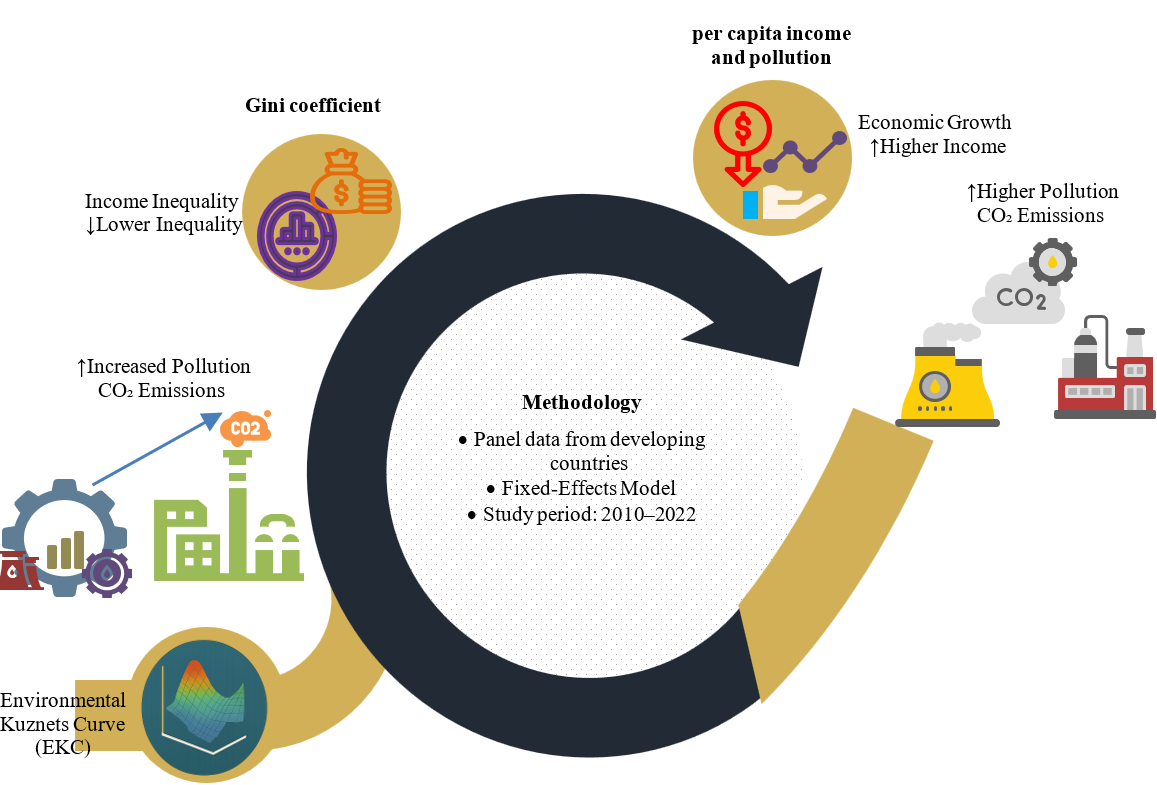
This research investigates the relationship between income distribution (measured by the Gini coefficient) and environmental pollution, specifically CO2 emissions, in a panel of developing countries (2010-2022). The study acknowledges that economic growth, often leading to increased resource consumption and pollution, necessitates sustainable development planning. It reviews existing theories like the Environmental Kuznets Curve (EKC), which posits that pollution initially rises with income before falling due to structural and technological shifts. Employing panel data analysis, the researchers utilized fixed-effects models after rejecting the pooled and random-effects specifications via Chow and Hausman tests. The key finding is a statistically significant negative relationship between the Gini coefficient and environmental pollutants, meaning that reduced income inequality is associated with increased pollution. Conversely, a positive and significant relationship exists between per capita income and pollution, indicating that as these developing nations increase production and income, pollution levels rise. The conclusion suggests that for these developing economies, efforts to increase per capita income and reduce inequality (lower Gini) currently result in greater environmental degradation, likely due to production methods heavily reliant on polluting, energy-intensive industries. Policymakers are advised to focus on strategies that decouple income growth from pollution, such as moving beyond raw material processing toward higher-value, cleaner industries
Downloads
References
Ehigiamusoe, K. U., Majeed, M. T., & Dogan, E. (2022). The nexus between poverty, inequality and environmental pollution: evidence across different income groups of countries. Journal of Cleaner Production, 341, 130863.
Zhou, A., & Li, J. (2021). Air pollution and income distribution: evidence from Chinese provincial panel data. Environmental Science and Pollution Research, 28(7), 8392-8406.
Liu, Y., & Wang, J. (2020). Environmental pollution, environmental regulation, and labor income share. Environmental Science and Pollution Research, 27(36), 45161-45174.
Yang, X., Geng, L., & Zhou, K. (2020). Environmental pollution, income growth, and subjective well-being: regional and individual evidence from China. Environmental Science and Pollution Research, 27(27), 34211-34222.
zhao, W., Hafeez, M., Maqbool, A., Ullah, S., & Sohail, S. (2021). Analysis of income inequality and environmental pollution in BRICS using fresh asymmetric approach. Environmental Science and Pollution Research, 28(37), 51199-51209.
Ansari Samani, H., Rouzbahani, M., Dalvandi, H., & Sadeghi, R. (2024). Income inequality and environmental degradation in the provinces of Iran. Environmental Health Engineering And Management Journal, 11(1), 25-30.
He, Z., Li, J., & Ayub, B. (2024). How do income inequality, poverty and industry 4.0 affect environmental pollution in South Asia: New insights from quantile regression. Heliyon, 10(13).
Khan, S., Yahong, W., & Zeeshan, A. (2022). Impact of poverty and income inequality on the ecological footprint in Asian developing economies: Assessment of Sustainable Development Goals. Energy Reports, 8, 670-679.
Xiao, D., Yu, F., & Yang, H. (2022). The Impact of Urban‐Rural Income Inequality on Environmental Quality in China. Complexity, 2022(1), 4604467.
Liao, L., & Li, Y. (2025). Pollution control and welfare growth: How environmental governance reshapes income inequality through population health improvement. Journal of Cleaner Production, 506, 145532.
Ma, B. (2022). The impact of environmental pollution on residents’ income caused by the imbalance of regional economic development based on artificial intelligence. Sustainability, 15(1), 637.
Luo, L., & Ma, X. (2021, May). Research on the impact of income gap on environmental pollution based on balanced panel data of 48 countries. In IOP Conference Series: Earth and Environmental Science (Vol. 781, No. 3, p. 032003). IOP Publishing.
Li, B., & Xiao, D. (2021). The impact of income inequality on subjective environmental pollution: individual evidence from China. International Journal of Environmental Research and Public Health, 18(15), 8090.

Downloads
Published
Issue
Section
License
Copyright (c) 2025 Khashayar Seyedshokri , Kuhzad Shiravand , Samira Basirizadeh (Author)

This work is licensed under a Creative Commons Attribution-NonCommercial 4.0 International License.