Technical and Economical Investigation of Water Alternating Gas (WAG) Injection on Oil Recovery actor
Keywords:
WAG, Gas injection, Economic Analysis of WAG, EORAbstract
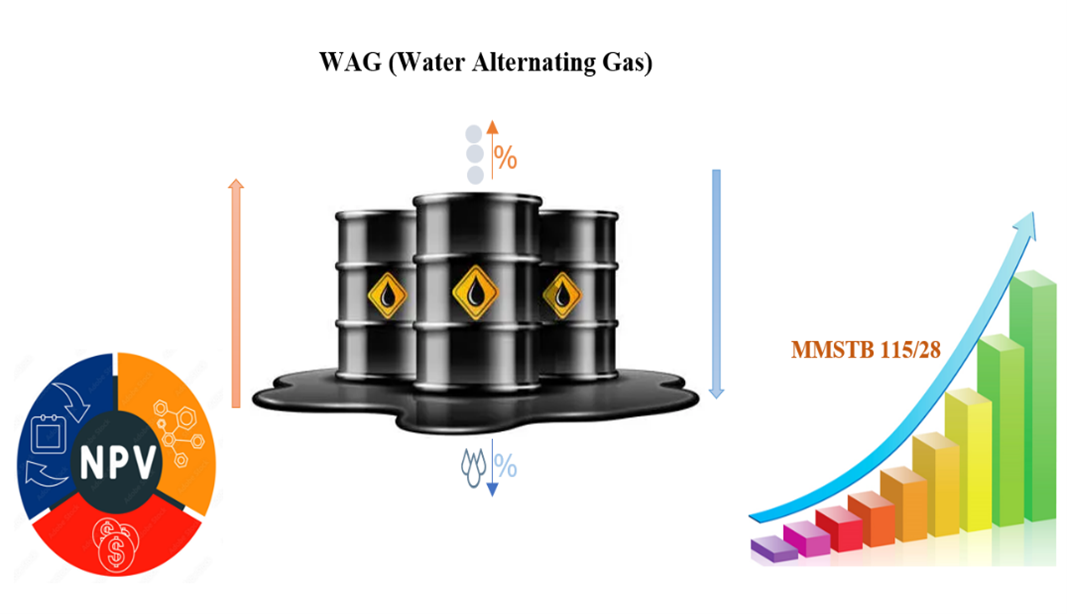
One of the derivative methods of gas-injection techniques is the water alternate gas (WAG) injection methods, wherein water and gas are injected intermittently. Oil recovery by the WAG injection has been attributed to contact the upswept zones, especially recovery of attic or cellar oil by exploiting segregation of gas to the top or accumulation of water toward the bottom. In this study the process of water alternating gas injection in a petroleum reservoir has been simulated. For this purpose, existing laboratory data are used and then the injecting fluid in the reservoir is modeled. The results of this method are compared with other reservoir development methods, such as gas injection or natural depletion. Various injection scenarios have been considered. Among the optimized scenarios, the WAG injection with 0.2 PV, 1:1 WAG ratio and 5 months water and 3 months gas injection period had the highest cumulative oil production of 115.28 MMSTB. The economic analysis of WAG injection has been presented for the most optimum oil production scenario (i.e. WAG-1:1 Ratio-5:3 Period scenario). The impact of economic factors such as the oil price, discount rate, OPEX, and CAPEX on the net present value (NPV) has been studied. The sensitivity analysis showed that the oil price has the greatest impact on the NPV which was followed by the discount rate and OPEX. However, the CAPEX has shown to have the least effect on the calculated NPV
Downloads
References
T, Babadagli. Journal of Petroleum Science and Engineering, 2007, 57(3-4), 221-246.
J.R, Christensen. E.H, Stenby. A, Skauge. in International Petroleum Conference and Exhibition of Mexico, 1998, Society of Petroleum Engineers.
W, Lyons. Gulf Professional Publishing, 1996, 2.
C, Brown. World Energy Resources: International Geohydroscience and Energy Research Institute, 2012.
E.C, Donaldson. G.V. Chilingarian. T.F. Yen. Enhanced Oil Recovery, II: Processes and Operations,1989.
M, Latil. Gulf Publishing Co,1980.
S, Tabatabaei Nezhad. A.R., et al. in International Oil Conference and Exhibition in Mexico, 2006. Society of Petroleum Engineers.
P, McGuire et al. in SPE Western Regional Meeting, 2005. Society of Petroleum Engineers.
T, Holt. E. Lindeberg. D. Wessel-Berg. Energy Procedia, 2009. 1(1), 4159-4166.
M, Cobanoglu. Kozluca Field, Turkey. in SPE Asia Pacific Improved Oil Recovery Conference, 2001. Society of Petroleum Engineers.
Y, Gong. Y. Gu. Energy & Fuels, 2015, 29(9), 5655-5665.
J.C, Heeremans. T.E. Esmaiel. C.P. Van Kruijsdijk. in SPE/DOE Symposium on Improved Oil Recovery, 2006. Society of Petroleum Engineers.
N, Jakobsson. T. Christian. in SPE Annual Technical Conference and Exhibition, 1994. Society of Petroleum Engineers.
L.W, Holm. Miscible Displacement, 1987. PEH Chapter 45..
D, Element et al. in IEA Collaborative Project on Enhanced Oil Recovery, 19th International Workshop, Carmel, California, 1998.
E, Braun. R. Holland. SPE Reservoir Engineering, 1995, 10(03), 222-228.
J, Sørbel. NTNU, 2015.
F.O, John. Optimization of A Water Alternating Gas Injection, 2015.
M, Zahoor. M. Derahman, M. Yunan. Brazilian Journal of Petroleum and Gas, 2011. 5(2).
M.J, Darvishnezhad et al. in Trinidad and Tobago Energy Resources Conference, 2010. Society of Petroleum Engineers.
X, Wu et al. in Canadian International Petroleum Conference, 2004. Petroleum Society of Canada.
D, Pritchard. R. Nieman. in SPE/DOE Enhanced Oil Recovery Symposium, 1992, Society of Petroleum Engineers.
A, Dehghan. S. Ghorbanizadeh. S. Ayatollahi. Transport in porous media, 2012, 93(3), 577-595.
S.M, Fatemi et al. Energy & Fuels, 2012. 26(7), 4366-4382.
L, Zuo et al. SPE Reservoir Evaluation & Engineering, 2014, 17(03), 326-339
B, Chen. A.C. Reynolds. SPE Journal, 2016, 21(03), 786-798.

Downloads
Published
Issue
Section
License
Copyright (c) 2025 Amirjafar Peykani (Author); Mohammad Ali Hatefi (Corresponding author)

This work is licensed under a Creative Commons Attribution-NonCommercial 4.0 International License.