An Artificial Neural Network Model to Estimate the Success Rate of a Project Based on key Success Factors
Keywords:
Project Management, Project Success, Assessing Project Management Success, Artificial Intelligence, Artificial Neural Network ModelAbstract
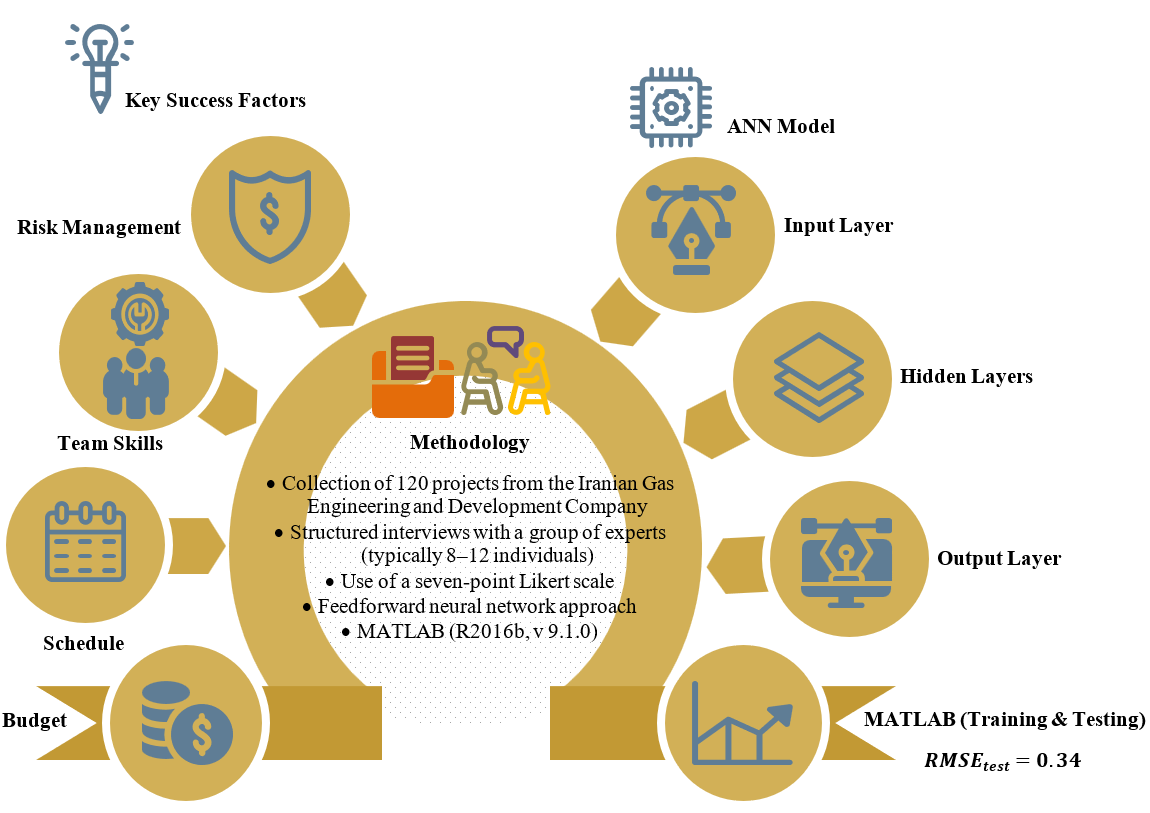
Projects play a crucial role in identifying economic trends and guiding strategic decisions in project-based organizations. However, due to limited resources, uncertainty, and environmental complexity, investing in projects has become risky. Since project success is the ultimate goal of companies, identifying the essential factors that lead to success is of particular importance. The aim of this study is to present a model for early project evaluation and success prediction, as a risk analysis technique, based on the identified success factors. For this purpose, 120 projects from the Iranian Gas Engineering and Development Company, a subsidiary of the Ministry of Oil, were collected. Primary data were gathered through structured interviews with a group of experts (typically 8 to 12 individuals), and the success of each project was evaluated by this group using a seven-point Likert scale (ranging from "completely" to "fully"). A feedforward neural network approach was then employed to examine the relationship between critical success factors (CSFs) and project success. The MATLAB (R2016b, v 9.1.0) was used to develop the ANN model and create a graphical user interface (GUI). The results showed that the model's performance, with a test , was very good and demonstrated strong generalization capability. The model's accuracy was also considered acceptable from the experts' perspective. In fact, the model is highly effective in predicting project success (based on the experience of project managers) and can be used as a practical tool for risk analysis to assist managers in making timely and appropriate decisions
Downloads
References
http://www.pmi.org/About-Us/About-Us-What-is-Project-Management.aspx [Retrieved 13-1-2015]
C. W. Kuen, S. Zailani, and Y. Fernando, African journal of business management, 2009, 3(1), 16-27.
G. W. Flintsch, J. P. Zaniewski and J. Delton, Transportation research record, 1996, 1524(1), 185-193.
R.J. Thieme, M. Song, and R.J. Calantone, J.Mark. Res. 2000, 37,499–507.
F. Costantino, G. Di Gravio and F. Nonino, International Journal of Project Management, 2015, 33(8), 1744-1754.
https://en.oxforddictionaries.com/definition/success
L. Ika, Proj.Manag. J. 2009, 40, 6–19.
R. Atkinson, International Journal of Project Management, 1999, 17(6), 337-342.
J.K. Pinto and D.P .Slevin, IEEE Transactions on Engineering Management, 1987, 34(1), 22-8.
B. N. Baker, D. C. Murphy and D. Fisher, In Project Management Handbook, ed. D. I. Cleland and D. R. King. Van Nostrand, New York, 1983, 669- 685.
W. Lam, European Journal of Information Systems, 2005, 14(2), 175-87.
D. Ashley, E. Jaselskis, and C.B. Lurie, Project Management Journal, 1987, 18(2), 69-79.
S.C. Ward, and C.B. Chapman, Int. J. Proj. Manag. 1995, 13, 145–149.
A. Jaafari, Int. J. Proj. Manag. 2001, 19, 89–101.
J.R. Turner, London: McGraw-Hill, 1999.
E. Cagno, F. Caron, and M. Mancini, Risk Manag, 2007.
H. Al-Tamimi and F.M. Al-Mazrooei, The Journal of Risk Finance, 2007, 8(4), 394-409.
R. Iftikhar and S. Menon, Umeå School of Business, 2011.
Project Management Institute, 2013. “A Guide to the Project Management Body of Knowledge, (PMBOK® Guide) – Fifth Edition”. Published by Project Management Institute, Inc.14 Campus Boulevard Newtown Square, Pennsylvania 19073-3299 USA, and ISBN: 978-1-935589-67-9, pp. 391–415. See also URL www.PMI.org, PDF files.
K. Anderson and A. Terp, Denmark: Copenhagen Business School Press, 2006, 27-46
D.S. Kezsbom and K.A. Edward, Wiley, New York, NY, 2001.
S. Grey, New York: Wiley, 1995.
P. Elkington and C. Smallman, Int. J. Proj. Manag, 2001, 20, 49–57.
Emsley, M.W., Lowe D.J., Duff, A.R., Harding, A. and Hickson, A., 2002. “Data modelling and the application of a neural network approach to the prediction of total construction costs.” Construction Management and Economics, 26(6), 465-472.
M. Günaydın and Z. Doğan, Int. J. Proj. Manag, 2004.
Y.R. Wang, C.Y. Yu, and H.H. Chan,. Int. J. Proj. Manag. 2012.
Y.Q. Chen, Y.B. Zhang, J.Y. Liu and P. Mo, J. Manag. Eng. 2012.
D. Dvir, A. Ben-David, A. Sadeh and A. J. Shenhar, Eng. Appl. Artif. Intell., 2006, 19(5), 535–543.
G.P. Zhang, M. Keil, A. Rai and J. Mann, Eur. J.Oper. Res, 2003.
F.Y.Y. Ling and M. Liu, Build. Environ, 2004, 39, 1263–1274.
M. Samsul Islam, L. Zhou and f. Li, School of Management Blekinge Institute of Technology, 2009.
K.A. Smith and J.N.D. Gupta, Irm Press, 2003.
J. Kamruzzaman, R. K. Begg and R. A. sarker, Idea Group Publishing, 2006.
O.A. Olanrewaju, A.A. Jimoh and P.A. Kholopane, IEEE International Conference on Industrial Engineering and Engineering Management., 2011, 738–741.
X.H. Jin and G. Zhang, Int. J. Proj. Manag, 2011.
I.A. LAI, PhD thesis, 2016.
https://www.slideshare.net/parabprathamesh/primary-sec
J.K. Pinto and D.P. Slevin, IEEE Transactions on Engineering Management, 1987, 34(1), 22-8.
MATLAB, 2016, neural network toolbox, user’s guide. www.Mathwork.com
P. Chidambaram, PhD thesis, 2009.
J.M. Hazebroucq, Proj.Manag. J, 1993, 40, 6–19.

Downloads
Published
Issue
Section
License
Copyright (c) 2025 Davood Jaafari , Mitra Akbari (Author)

This work is licensed under a Creative Commons Attribution-NonCommercial 4.0 International License.